
🌐 Condoleezza Rice’s 22-Country Prophecy: The Fate Awaiting Iran as the 21st Nation
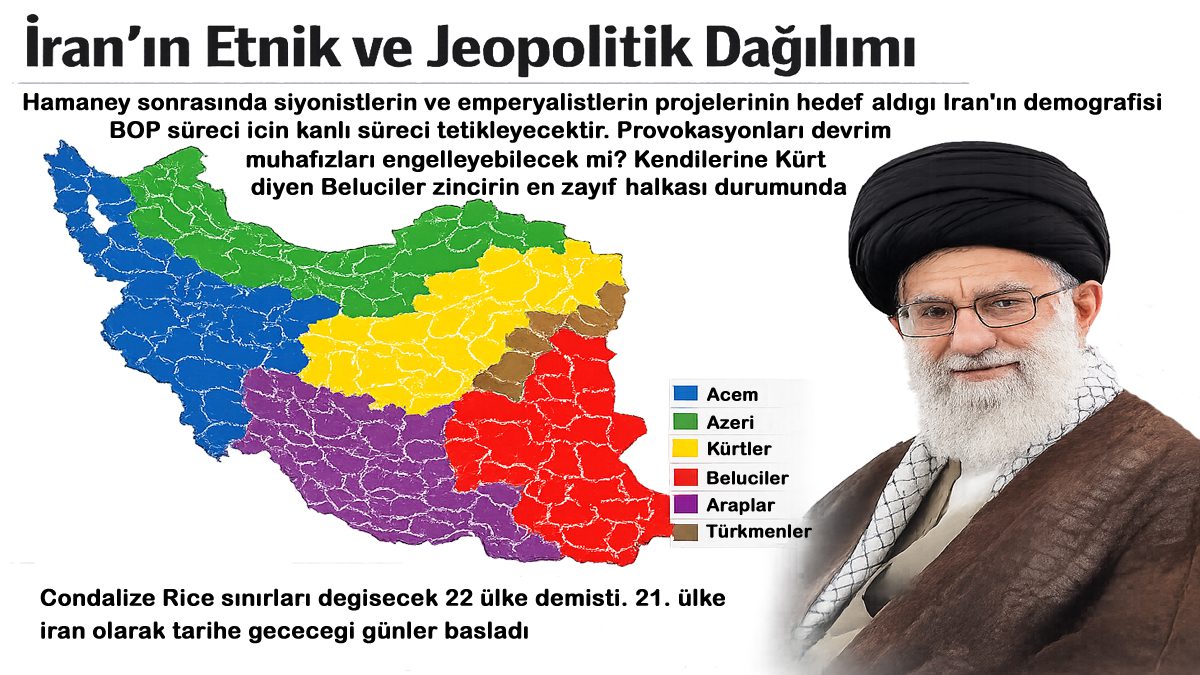
Years ago, during a visit to Turkey, former U.S. Secretary of State Condoleezza Rice stated in a televised program that the borders of 22 countries, including Turkey, would change. Today, we stand at a historical crossroads. What fate awaits Iran, the 21st nation on this list? We are witnessing the final turn of a long-standing geopolitical design.
🧩 Iran’s Demographic Map: A Puzzle of Ethnic Tensions
Iran’s demographic structure is uniquely complex. In the southeast, the Baloch people, who often align their identity with Kurdish movements, represent a significant fault line. Following the eventual post-Khamenei era, the first spark of unrest is expected to ignite in the Baloch-populated regions as soon as the initial mourning period subsides.
🛡️ The Marginalization of the Arab Population
In the southwest, a scenario to pit the Arab population against the Persian majority has long been in play. Although the Revolutionary Guard previously froze this process through suppression, the spark of a new conflict would have devastating ripple effects across both Iran and southern Iraq, where Shia influence remains a dominant force.
🏹 Azeri and Turkmen Populations in the North
The long-held aspirations of the Azeri population in Northern Iran to reunite with Azerbaijan are no secret. This historical cycle stands as one of the most critical factors that could accelerate the disintegration of Iran’s central authority.
⚖️ Can Pezeshkian’s Popularity Save the Union?
While President Pezeshkian’s sympathetic image is recognized both domestically and internationally, his political weight may not be enough to hold the diverse and fractured elements of the country together against external pressures and internal shifts.
☢️ Is the Real Cause Nuclear Activity or Energy?
Although systematic attacks on Iran are justified by “nuclear activities,” it is a reality that Iran’s uranium enrichment has not yet reached the level of producing a nuclear bomb. Why then is this excuse prioritized? Zionist and imperialist powers cannot openly admit they are targeting Iran for its strategic energy partnership with China. Interestingly, while military partnerships exist with Russia, Moscow has consistently left Tehran isolated during actual military interventions.
🚀 The Afghanistan Projection and Regional Proxies
Iran’s eastern border with Afghanistan has become a severe risk factor. It is well-known that the administration in Afghanistan is prepared to serve U.S. interests to maintain its own standing. As Israel and the U.S. implement their “Iran Project,” local collaborators will play their parts. The recent conflict between Afghanistan and Pakistan was no coincidence; it served to distract Pakistan—a nation capable of challenging India—away from Iran’s integrity.
🇹🇷 Turkey’s Strategic Role in Iran’s Future
Turkey’s primary goal will be to preserve Iran’s territorial integrity. However, whether we will succeed remains to be seen. The U.S. and Israel have consistently hindered the strengthening of the Turkish Air Force precisely because they do not want an operational Turkey thwarting their regional designs. With our current aerial strength, we face a dilemma: protecting Syria, defending interests in the Mediterranean, or ensuring the integrity of the 21st country—Iran.
Ultimately, Turkey remains the 22nd target of the Greater Middle East Project (BOP). It takes no great wisdom to see that after the Iran project is completed, eyes will turn toward Anatolia. The recent rhetoric regarding internal fronts and the status of terrorist leaders is a reflection of the fact that we are the ultimate target.
Turkey has the potential to be the most influential actor on Iranian soil. Through deep intelligence activities and state authority, Turkey can prevent Azeri and Turkmen populations from falling into provocations. If the ruling “Molla” administration cooperates with Turkey, the BOP project could end up in the “trash.” If they refuse, the thousand-year-old Turkish state tradition will be forced to establish its own sphere of influence to prevent a power vacuum that Zionism would otherwise fill.
🎢 Trump’s “Sirat” Process and the Global Order
Donald Trump, currently cornered by the Epstein files, is navigating the most precarious period of his political life. The “New World Order” he leads is one spark away from chaos. He must either break China’s economic dominance or watch the U.S. decline. Since a direct military conflict with China is unfeasible, the sustainability of cornering China through local conflicts (like in Venezuela or Iran) is highly debatable. China can bypass energy crises through Russia, and if it expands its influence over Central Asia, Africa, and South America, neither the U.S. nor Israel will have the strength to resist.
I will continue to analyze the weekly reflections of these evaluations regarding Iran’s future in my upcoming reports.